Beyond the Assembly Line: Tesla's Optimus and the Coming Robot Revolution
I. Introduction: Meet Optimus – Your Future AI Companion
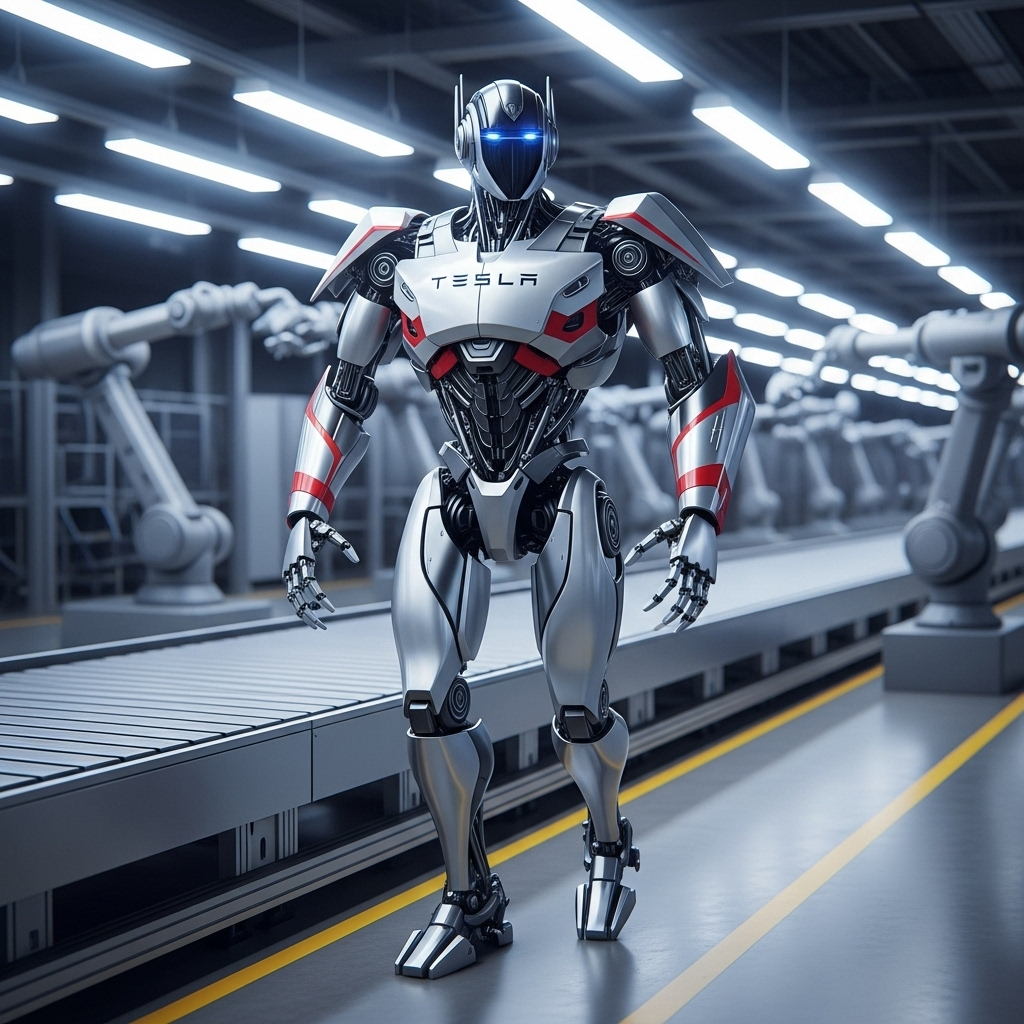
Picture this: a world where folding laundry is a distant memory, or maybe your job involves designing robots instead of something… less inspiring. That's the promise, or at least a slice of the promise, behind Tesla's Optimus. Also known as the Tesla Bot, this bipedal humanoid robot is being designed, rather ambitiously, to tackle what Elon Musk calls "dangerous, repetitive, and boring" tasks. The kind that fill factories and, let's be honest, our homes.
Musk's vision is, characteristically, grand. He's suggested Optimus could eventually overshadow Tesla's entire electric vehicle business. A bold claim, yes, but one that hints at a future he sees as an "age of abundance," driven by readily available robotic labor.
This post isn't about blindly accepting that vision. Instead, let's take a look at the Optimus project. We'll trace its evolution from a conceptual drawing to a (somewhat) functional prototype, explore the tech that makes it tick, and, perhaps most importantly, examine the ethical and practical questions it raises. Are we truly on the cusp of a robotic revolution, or is this just another case of overhyped AI?
II. From Concept to Reality: The Optimus Journey So Far
- Birth of a Bot (August 2021): The Optimus story began at Tesla's AI Day in August 2021. The unveiling was... unusual. Instead of a working robot, we got a person in a robot suit dancing awkwardly on stage. It was more of a symbolic gesture, a placeholder for the ambitious vision Musk outlined that day.
- First Steps (September 2022): Fast forward to AI Day 2022, and things got a little more real. We saw actual, albeit semi-functional, prototypes. "Bumblebee," as one was nicknamed, walked untethered across the stage. Videos showed early arm and leg movements, with the bot managing simple tasks like carrying boxes. Clunky, sure, but a start.
- Gains & Graces (December 2023): The Optimus Gen 2 debuted in December 2023. It was sleeker, moved faster (apparently 30% faster walking speed), and had noticeably improved hands. What struck me here was Tesla's emphasis on in-house manufacturing – designing and building almost everything themselves. That's a pretty significant commitment, and potentially a competitive advantage down the line.
- Factory Floor & Beyond (May 2024 - July 2025): From handling battery cells in Tesla factories to more recent demos showing it stirring food, vacuuming, and even (somewhat clumsily) serving popcorn at a Tesla diner, Optimus has been venturing beyond the lab. The claim is that it's learning by watching humans, a process that could accelerate its development. How much of this is genuine autonomy versus remote control, though, is a question we'll need to explore.
III. The Brains and Brawn: What Makes Optimus Tick?
- Humanoid Form, Superhuman Strength: At roughly 5'8" and around 125 pounds, Optimus is built to resemble us, at least in general shape. It's supposedly able to carry a 45-pound payload and deadlift 150 pounds. More importantly, it needs to do this while maintaining balance on uneven surfaces.
- The Tesla AI Core: The heart of Optimus is an AI system that draws heavily from Tesla's Full Self-Driving (FSD) computer. Think of it as an AI chip trained on a neural network, giving it the ability to learn and "see" the world in real-time. There's even talk of integrating xAI's Grok chatbot for voice interactions, which could be interesting, or potentially problematic.
- Seeing & Feeling the World: Optimus doesn't just see; it senses. Eight autopilot cameras in its head, tactile sensors in its fingertips, and force/torque sensors in its joints and feet provide a comprehensive understanding of its surroundings. Sensory fusion, as it's called, combines all this data to create a more complete picture.
- Dexterity Unleashed: The hands are key. Gen 2 had 11 degrees of freedom; Gen 3 is shooting for a whopping 22. Why does this matter? Because it determines how well Optimus can manipulate objects. Picking up an egg without crushing it is a classic test, but also sorting colored blocks. These are the kinds of tasks that require real dexterity.
- Long-Haul Power: The current 2.3 kilowatt-per-hour battery provides up to 5 hours of operation, but the aim is for 8-10 hours in future versions, with significantly faster recharging times – potentially just 10 minutes for a full charge. That's critical for making it a practical worker.
IV. The Great Debate: Hype vs. Reality
The Cheerleaders (Optimism):
- Some robotics experts see the rapid progress as encouraging, calling it a solid starting point.
- Tesla's control over the entire manufacturing process, from design to production, is viewed as a major advantage.
- Analysts see Optimus as a potential catalyst for growth, driving automation and generating substantial revenue.

The Skeptics (Concerns):
- "Is it *really* autonomous?" Many demonstrations seem to rely on remote control, raising questions about true autonomy. The popcorn-serving demo comes to mind – impressive, but is it really "thinking" for itself?
- Ambitious Timelines & Production Hurdles: Tesla's history of missing deadlines is a concern. Reports of technical issues, especially with the hands, overheating, and battery life, have led to production slowdowns.
- "Do we even need a humanoid for *that*?" Some argue that simpler, specialized robots might be more efficient for many industrial tasks. Is a humanoid form really necessary, or just cool-looking?
- Elon's Hype Machine: Musk's predictions, like a $25 trillion valuation for the robot division, are often viewed with skepticism. It's easy to get caught up in the hype, but important to separate current capabilities from future potential.
V. The Ethical Tightrope: Society, Jobs, and Privacy
- Job Transformation (Not Just Displacement): While job losses are a valid concern, especially in manufacturing, some argue that new jobs will be created in robot maintenance, programming, and oversight. Humans might move into more creative roles.
- Beyond the Factory: Assisting the elderly, helping people with disabilities, providing companionship – the potential societal benefits are huge.
The Darker Side:
- Privacy & Surveillance: Cameras and sensors raise privacy concerns. What data is being collected, and how is it being used?
- Safety First: What happens if Optimus malfunctions? Who's liable if it causes an accident? Reports of a Tesla factory worker being injured by a robot are a stark reminder of the risks.
- The "Master-Slave" Dynamic & Dehumanization: Could reliance on robots lead to laziness, entitlement, or a decline in human interaction?
- Bias & Misuse: If trained on biased data, Optimus could perpetuate inequalities. And what about the potential for misuse, or even weaponization?
VI. What's Next for Optimus? The Road Ahead
- 2025: Internal Rollout & Gen 3 Prototypes: Tesla plans to use thousands of Optimus units in its own factories this year. Musk expects "exquisite" Optimus 3 prototypes by the end of 2025, with potential pre-orders in October for a base model around $16,000.
- 2026: Commercial Debut & Mass Production: This is the target year for commercial sales and full-scale production of the Optimus V3. Musk has even floated the idea of Optimus delivering meals to cars and being sent to Mars on a SpaceX Starship.
- Beyond 2026: A Million Bots a Year? Tesla's long-term goal is one million Optimus units per year within the next five years, with millions in Tesla factories by 2029. The robot division, according to Musk, could reach a $25 trillion valuation.
- Continuous Evolution: Expect AI enhancements, increased task versatility (3,000 tasks for V3, up from V2.5's 1,500), and hardware improvements like a digital display face and more advanced hands.
VII. Conclusion: The Dawn of a Robotic Era?
Optimus is a fascinating project, pushing the boundaries of robotics and AI. It has the potential to reshape our world, but also raises significant questions about ethics, society, and the future of work. Whether it truly heralds a robotic revolution remains to be seen. But it's a conversation worth having, and a technology worth watching closely.
Sources:
- BuiltIn.com
- Qviro.com
- Wevolver.com
- RobotsGuide.com
- Wikipedia.org
- RockingRobots.com
- IndiaTimes.com
- Tesla.com
- AccelerationRobotics.com
- BDtechtalks.com
- Notateslaapp.com
- Teslarati.com
- Ainvest.com
- Digitimes.com
- TheOptimus.ai
- AIOptimus.com
- TheBigWhale.io
- OptimusAI.org
- YouTube.com
- Viso.ai
- BrianDColwell.com
- TechEBlog.com
- TopSpeed.com
- Medium.com
- Electrek.co
- EV-A2Z.com
- MikeKalil.com
- GuruFocus.com
- VNExpress.net
- SecurityOnline.info
- QZ.com
- Artificial-Intelligence.blog
- InsideEVs.com
- TowardsDataScience.com
- SustainableTechPartner.com
- CleanTechnica.com
- SeekingAlpha.com
- RoboZaps.com
- Investing.com
- Cantechletter.com
- Mitrade.com
- CoinCentral.com
- Reddit.com
- UK.com
- IntiMedia.id
- Cybersecurity-Magazine.com
- Graphie.co.id
- FENews.co.uk
- BombaySoftwares.com
- OptimisticStorm.com
- Cleveland13News.com
- Ubos.tech
- Cybernews.com
- BrockPress.com
- AutoEvolution.com
- RetailWire.com
- VOANews.com
- HumanoidRoboticsTechnology.com
- Lapaas.com
- InvestorPlace.com
- TheChicIcon.com
- NewsbytesApp.com
- IndiaToday.in